It’s always interesting seeing how buildings turn out looking at nighttime. Much of it seems to reflect the lighting decisions, facade texture, and colors. I’m a fan of these LED pole lights lighting the curve along the sidewalk- they give a solid definition to the property boundaries, and may provide a good visual cue to drivers.
Several of the units look completely finished from the outside, as I imagine the unlit ones probably are as well. The second level 8,600 SF Class-A office space for Warren Real Estate and the Park Foundation is still being worked on, along with some aspects of the exterior like support column wraps and garage doors.
INHS’s Breckenridge Place is now officially leasing for occupancy, with 50 one and two bedroom units coming online in this brand new LEED Platinum building. Ithaca Neighborhood Housing Services has posted an informational video on Youtube, describing features of the building with shots of the interiors and views. The window shades have been going up above each street-facing window, and as I walked by a day ago, the ground floor laundry room at the corner had washers and dryers fully installed.
I’ll have more information to share about the project next week (I’m employed by Travis Hyde Properties, so I’d rather not publish any specific plans or materials before they’re made public). What I’d like to do is provide a series of posts and updates as the project progresses. I hope it will be interesting and informative, and provide a good look at what’s involved in these kinds of projects.
Incubator Space Rendering:
Render property of Cornell University
To start, here’s a brief history of the building: the Tudor/Gothic Carey Building was finished in 1922, and was designed to match the Tudor Revival entry facade of the Strand Theatre, which sat directly to the west (shared walls), and then north and behind, filling what is now a dirt lot for parking.
Former Strand Theatre footprint:
Carey Building, 1930s:
The Strand Theatre Entry:
Strand Theatre and Carey Building:
The building was built by Henry A. Carey, an insurance broker, whom owned the “Carey McKinney Group,” an insurance brokerage, later bought by Tompkins Trust Company in 2006. The building has housed a variety of tenants over the years- the earliest records I could find were for the NY Telephone Company in 1933, back when some commercial leases were recorded as deeds in public record. Mayers moved to the building in 1968, and the picture from the 1930s shows a haberdashery, oriental rug shop, Dunlop, and the photo from ~1975 the late 60s or 70s (I’m not sure) shows a Pet shop.
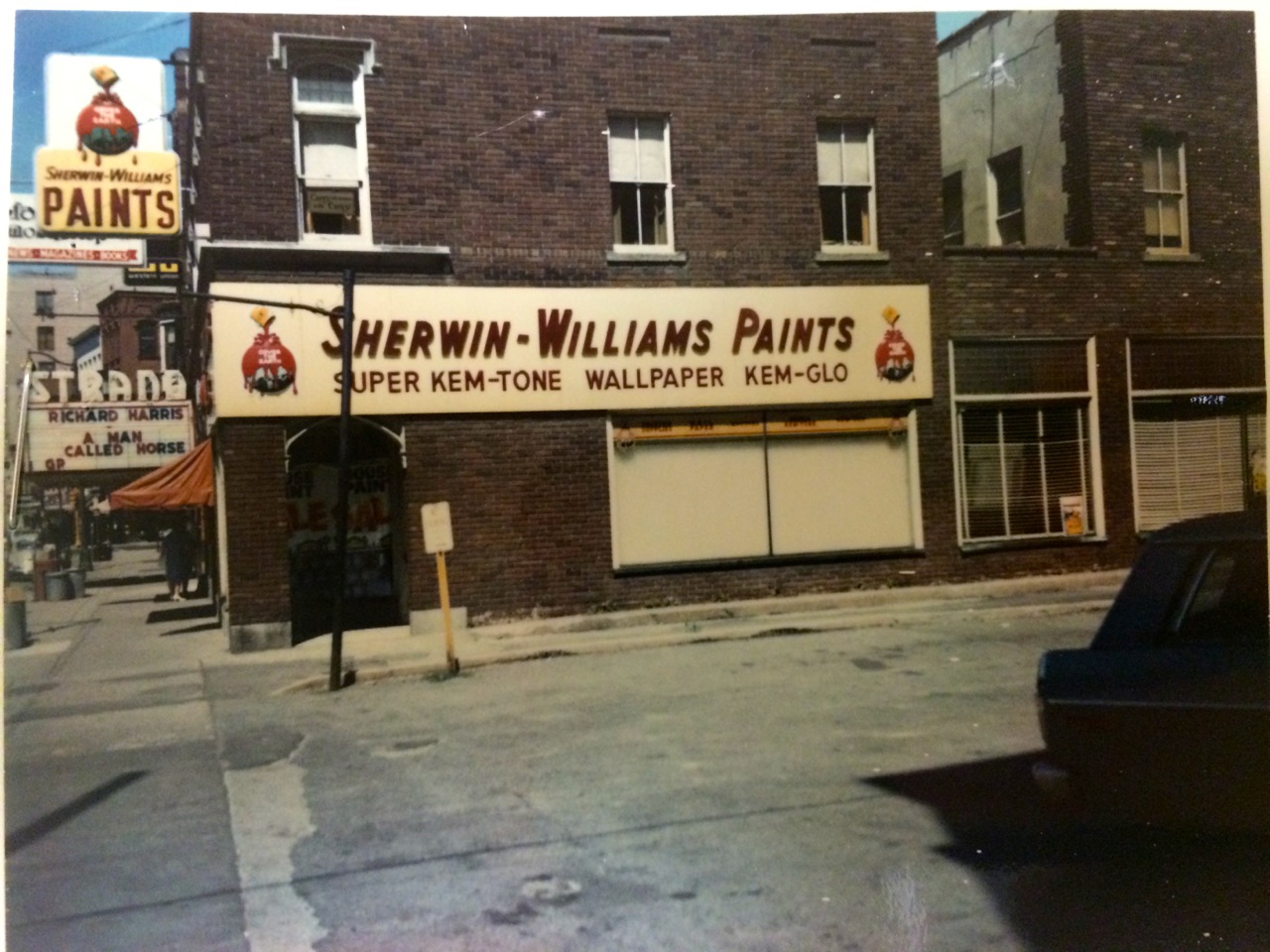
The second story was previously shaped like a “U”, with the top facing east, and windows facing inwards for daylight, shown in the 1970 photo below, when Sherwin-Williams occupied part of the first floor. The cutout was later roofed, and subsumed into the second floor interior space. The Strand Theatre (built in 1916) was demolished in 1993 after being closed for many years.
This is a relatively image-heavy post, and there are still so many details I’m leaving out, but I hope these shots taken from Sasaki‘s final presentation and the bid drawings documents give a rough idea of each of these features.
Benches, Tables, and Bike Racks
Part of the new design is focused on providing multiple seating options with fixed benches, fixed swivel chairs and tables, and also some movable seating areas. The previous Commons design relied heavily on wide concrete planters for bench seating, but the new design allow for easier re-configurations over time.
The seats and bike racks will be from Landscape Forms, a company out of Kalamazoo, Michigan (see Parc Centre, Catena, Escofet (benches), and Bola (bike racks))
Plantings
As I’ve stated before, I’m quite far from a working knowledge of plants, but I think these look to be tasteful options, and the angular ground cover designs are certainly interesting. I hope that the trees are trimmed so that they don’t grow to expansive- the view of the facades on the Commons has really grown on me, and all of the tree options max out at heights of 25 feet, and all the way up to 100 feet for the Honey Locust (although there’s probably not enough soil to provide the nutrients to grow that big).
Bernie Milton Pavilion
Named after the much-loved and sorely missed Bernie Milton (1942-2002) the Soul musician, and former DJ at WICB Radio, the proposed pavilion is an interesting steel and glass structure, designed to be situated at the end of Bank Alley. The roof will funnel water onto a shaded drip piece to provide effect, then down into a trench drain. The positioning at Bank Alley is designed to draw interest from Seneca Street, and provide more space for concert venues, since viewers will now have a much longer line of sight.
Gateways
Out of all the features, I have to admit, these are probably my favorite. The former signs were rather small in comparison, but these large gateway structures are perfect for giving visitors a strong first impression. For people that have never been here, it’s not so easy to identify where the Commons is located. Large, tasteful signage goes a long way.
Water Feature
The water feature is a series of stepped-up stone blocks with water misting jets and puddle drains embedded in the crevices, and one under a stone cantilever, inspired by the effect of water streaming over rock layers in the Ithaca’s gorges. The water lines will run south to a main water vault with pumps and drains. It’s no Trevi Fountain, but I think it’s a rather well-planned and inspired design.
Phase Three (the last phase) of the Commons Rebuild project will start this Spring (bid opening is January 23rd), with the focus on installing the surfaces and amenities for the redesign. The full scope and contract documents run up to the 1,000-page range, so I thought I’d condense a few of the items down with basic explanations on finishes.
Erosion & Soils
To prevent soil erosion and ensure proper drainage, cast iron surface and scupper drains will be put in place, much like the ones that exist now, and current drains will be cleared of any existing debris. The drains are primarily located in the side areas where surface water funnels, since the surface is designed to elevate slightly towards the center, much like a street. Each drain then feeds into the main stormwater sewer via PVC pipe.
Surface Materials
The surfaces will mainly comprise of textured and non-textured granite pavers, mortared granite pavers, concrete pavers, and cast in place concrete paving. The granite pavers will be supplied by J.C. Stone (or equivalent- see Englishman’s Bay), and the concrete pavers will be from Hanover Architectural Products (or equivalent- see PlankStone).
Electric Utility Enclosures
Pretty self-explanatory- there are two different sizes, with various locations.
If you’ve travelled down Seneca Street in the recent past, you may have noticed a rather unique project going up like nothing else that exists in Ithaca. This is the Longest Night Solstice Tower project by Barradas & Partners Architects, and Ciappa & Marinelli Builders (they built the 2009 GIAC project, and work on many custom houses). Barradas has a particularly interesting design portfolio, and this project is no different: the inspiration for the design comes from several historic precedents that may not be common knowledge for most people, and was certainly not known to me before learning about the project.
To begin chronologically, one of the earliest tower house precedents is out of Shibam, in modern-day Yemen, with towers dating all the way back to the 3rd Century AD. It’s a UNESCO World Heritage Site, with tower houses made out of mud brick reaching up to eleven stories high. They were originally designed for defense from Bedouin attackers, and each floor has only one or two rooms.
Another precedent is the famed medieval town of San Gimignano, in Siena-Tuscany, North-Central Italy, also containing a UNESCO World Heritage site: the town center, with 14 conserved towers. Many towns and cities in Italy contained house towers in the past, but San Gimignano provides the most well-conserved example all in one compact cluster.
Towers haven’t always yielded successful and long-lasting settlements however- the bundles of tower buildings that made up the former Kowloon Walled City in Hong Kong is a good example of basically what not to do. The close proximity of tall, compacted-footprint buildings with few open spaces forced the development of complex, maze-like pathways from one building to the next, with very little open room to travel, hang laundry to dry, vent air, or deal with waste. Construction was essentially unregulated, and apartments were typically very small, sometimes without any utilities. After a longstanding struggle between residents and the Hong Kong authorities, the inhabitants were evicted starting in 1987 and the city was demolished in 1993.
To turn to a more recent and notable modern example, these two structures sit on the coast in Kobe, Japan: designed by Tadao Ando, the 2003 4×4 House is an iconic tower house project (he’s quite a famous Architect, check out the Church of Light, and the Water Temple). Each level is just one room, with some levels serving multiple functions, much like Barradas’ project.
I had a tour of the Longest Night Solstice Towers project with Architect John Barradas a couple weeks ago, and even though the first tower is not yet finished, it’s an interesting space to walk through.
The design calls for two identical towers connected by an overhead elevated walkway above a shared foundation path. The foundation footers are quite generous, and the foundation walls provide a crawl space for plumbing and maintenance access. The stair tower is located along the northern wall, and the structure itself is all wood framing (with a vertical guy-wire at two corners, and a central framing column along the interior center wall forming the stair tower). There’s room for two parking spaces in the rear yard, and a shared central area between the towers.
All the doors above the ground level open to the inside, with protective outdoor railings, serving as both a window and a door to fresh breeze- essentially making an enclosed terrace out of a room with an open door. The 12″ x 12″ windows are block glass, serving as small clerestory windows on each level. The ceiling joists will remain exposed, and although it doesn’t look it from a distance, the exterior is all wood. The towers will be fully-equipped with sprinkler systems.
The first level of each will contain a living area, kitchen, and a bathroom with toilet, sink and standup shower. The second level will contain two mirrored bedrooms with separate sinks in the shared hallway, and the third level will contain the master bedroom, along with a private bathroom. The top level contains space for laundry and storage at the top of the stairs, and a door to the outside roof terrace, with the stair tower roof designed to collect and funnel rainwater into the terrace garden.
First Level for living space, kitchen, and full bathroom.
Second Level for two bedrooms and two sinks.
Third Level for master bedroom and bathroom.
Top Level for laundry, storage, and the roof terrace.. and a really nice view.
The lot is quite small and skinny (33′ x 93′, 3069 square feet) and is zoned R-3b, so this project is building to the maximum stories allowed, and in addition, the foundation connection between both buildings is an intentional design feature that deems the project a singular structure by code. It allows for the separation and privacy of two separate dwelling units (houses), which would’ve been non-compliant under the current code if they were separate structures, because of the small lot size. It’s a rather clever workaround, and given the immediate area, the project seems to be building an appropriate density. It would be interesting to see how a series of tower houses would function at similar proximity, especially since they could easily be designed differently to accommodate a variety of configurations for small to large families, or for accessibility.
I think what impressed me the most was the focus on getting the most out of each square foot, but still allowing for adequate space at each level. The material choices are modest and pragmatic, and the design of each feature from door swings to closet dimensions is slick and well-thought out. I look forward to seeing this project as it nears completion- it’s an intriguing example of design that “makes things work while still pushing the envelope.”
The crossing lights and automobile signalling lights have been installed on each of the poles, but the signalling sequences have yet to be programmed, and thus, the intersection is still an all-way stop- however, both lanes heading into the City on Mitchell Street have been opened-up for a few weeks now. The project contract sum is $342,677, awarded to Binghamton Road Electric, LLC (Bothar Construction), out of Binghamton, NY. $150,000 of the cost is being paid for by Cornell University, through the Cornell/Community Transportation Initiative.
Slight progress since November, but I would bet that much of this is on hold until the holidays are over or once the weather is a bit more forgiving. The roof of Goldwin Smith Hall is being replaced as part of the enabling work for the Klarman Hall project. The new electric and telecom concrete duct along East Avenue has been covered over now, so further excavation and the remaining enabling work will probably be completed early this year to prep for construction season.
Here are some current images of the western Statler Hall entrance that Cornell is planning to renovate into a redesigned vestibule and facade, expanded second story above, and landscaping in front. Something I hadn’t noticed before- the proposed stone base wall sections will match the existing ones below each ground floor window along East Avenue, and the sections along College Avenue that were completed as part of the Tower and Beck Center Renovations. The proposed facade will also match the original limestone block from the 1949 build, which the current entry does quite well too.
Cornell’s future home for the CIS program, Gates Hall has made some exterior progress since late November, however, I’ve noticed that the facilities page now indicates (on the right-hand side) that early 2014 is the scheduled opening, rather than December 2013 as previously announced. The angular south-west entry way retaining walls have been poured, the stair structure and rebar is in place, and a couple more pre-fab concrete “feet” have been assembled on the western entryway. I imagine that the interior has been the major focus for finishing-up to get the school moved-in; Spring instruction starts January 22nd, although, judging by peaks from the outside, the goal may be during semester.