Ithaca Builds

Mapping, photos and information for Ithaca construction and development projects

Project Updates

130 E Clinton St Planting Plan

July 2, 2013 // by Jason Henderson

I’ll admit- I don’t know much about trees or plants, but here’s the planting plan submission and existing survey of the plants on the parcel for this project. Essentially, there’s nothing rare or unusual, and the planting plan looks quite respectful. At the planning board meeting there was some concern that the existing trees may be old growth, but it’s clear from the report that there isn’t any evidence of that. The development team indicated that there were significant remains of previous structures that had turned up in the soil study as well, like pieces of what was once a staircase, and probably a house or a shed.


Thurston Ave Minor Site Plan Revisions

July 1, 2013 // by Jason Henderson

Just some minor changes to the site plan here: curb and signage revisions from HOLT for RABCO Highland House’s project next door to their existing apartment complex. This project hasn’t changed all that much since its first site plan submission, probably because of few objections to the plans; definitely a “fitting addition.”


Hotel Ithaca Marriott Final Design

June 30, 2013 // by Jason Henderson

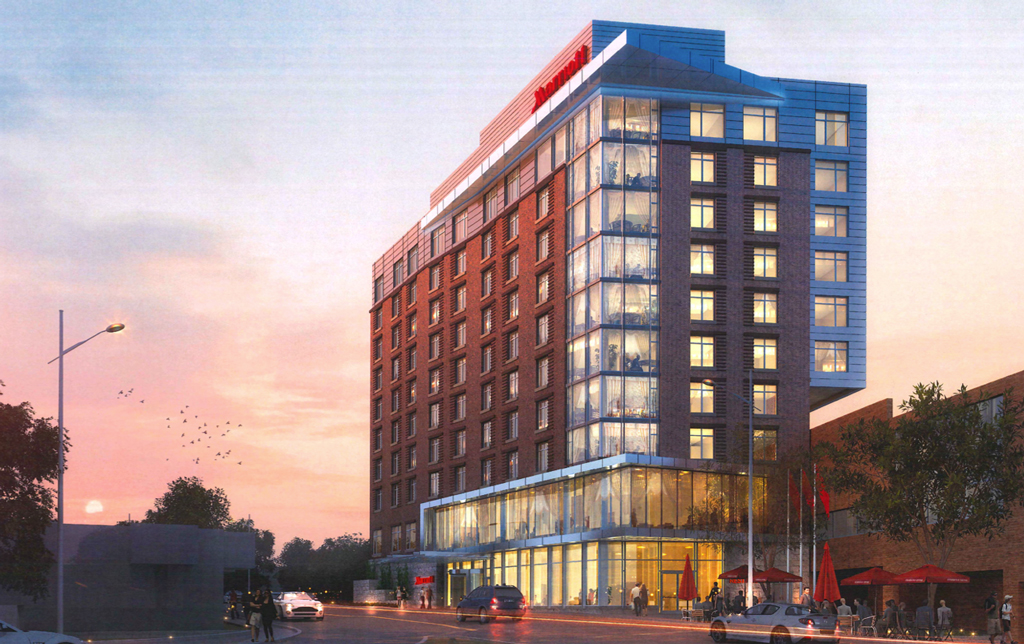
Marriott-Shot

Here are the final design submission documents for the future $32 million, 159-room Hotel Ithaca Marriott. These have the full floor plan layouts for every floor, lots of site renderings, a cutout shot of the cantilevered section, elevations with facade, framing, and lighting details, and various site plans. Cooper Carry is a national architecture and design firm, and the developer Urgo Hotels is based in Bethesda, Maryland, with over 30 hotels under ownership and/or management, primarily along the upper east coast and Florida.
 
The staging diagram shows loading zones on Aurora and Green streets, with the hoist located just north of the current bus shelter. The lanes on Aurora and Green will be closed off for 2-3 days per week in the daytime during the construction. It’s easy to see why: there’s no feasible alternative. Also with an urban site this small, I imagine most of the deliveries will be just in time, with trucks lined-up Green Street to unload one after the other. I haven’t seen a project timeline or schedule anywhere, but the plan late last year was to start construction in March 2013. The design has changed a bit since first proposed, and the granting of the $3.6 million tax abatement by the Tompkins County IDA pushed the project along earlier this year.


Gates Hall Renderings & Project Site

June 28, 2013 // by Jason Henderson

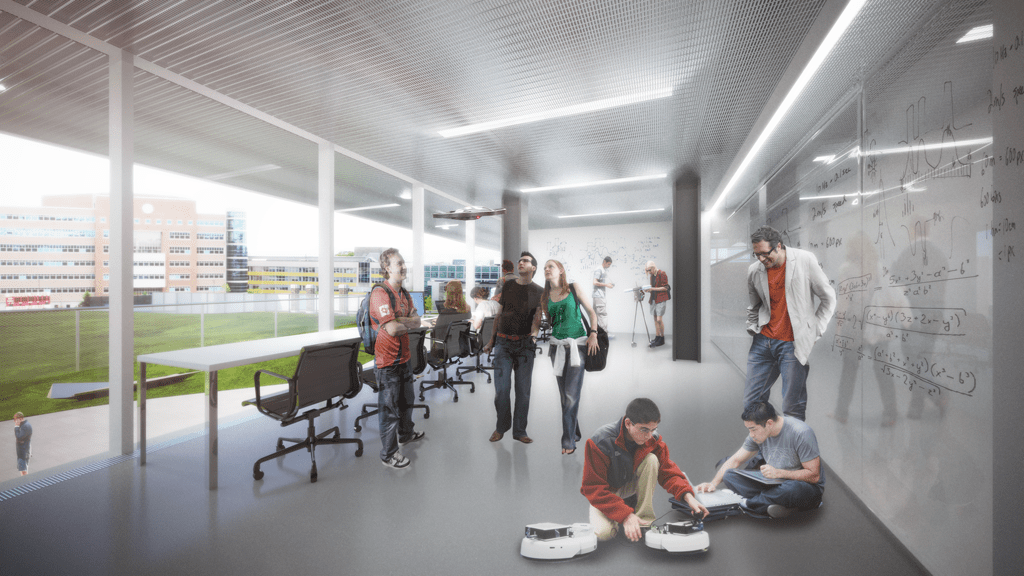
120210_SUMMER-1l996qh

This project was well underway about a year ago, but I figured putting up some renderings from the really nice project webpage is appropriate. The project page has an extensive series of construction photos, a live construction cam, and a 3D Interactive tour Flythrough, which takes you through this new home of Cornell Computing and Information Science (CIS).

Thom Mayne and his team at Morphosis designed the new building, the product of an early $25 million donation from Bill & Melinda Gates and a further $35 million on top for a total of $60 million. The school itself is relatively new, has about 80 faculty, and consists of three main programs: computer science, information science and statistics. The goal of the program is “to be the national model for education and research that supports the information economy.” It will be interesting to take a peek inside once it’s completed. I imagine that an aramada of cutting-edge facility technology will be commonplace in the building.

130 E Clinton St Feasibility Analyses

June 28, 2013 // by Jason Henderson

Inevitably in the Site Plan Review Process, the subject of this project being situated on a challenging grade came up (35 degrees in some areas), and the developers have prepared an impressive study showing how this will be accomplished. The main obstacle is assessing what’s called “global slope stability,” which is the assessment of the overall strength of the slope. The project must be constructed and engineered so that the top layers do not slide with the additional weight of construction equipment and the buildings themselves.
Gary Wood, an engineer in Ithaca conducted the study with the assistance of several specialist contractors (Nothnagle Drilling, TG Miller PC, Ravi Engineering, and information provided by the City from Bermingham Construction for the 1992 Police Station build next door).
The primary implications for the project include the planned deployment of soil monitors that will detect any shifts of the slope during construction, and that the foundations will be constructed “cast-in-place” (dug out, then poured on-site). See the third PDF section for a sketch of the excavation plan sequence and the fourth for the building construction sequence.


Cayuga Place Two Renders & Elevations

June 27, 2013 // by Jason Henderson

These elevations and rendering were released last year by Bloomfield/Schon + Partners, the developers. Not sure what the status is currently, but there’s been some minor site prep (see photos).

Klarman Hall Initial Site Plan Presentation

June 27, 2013 // by Jason Henderson

The first PDF here is Cornell’s Facilities Services brief on this capital project, and the second is the initial presentation to the City of Ithaca Planning Board by Koetter Kim & Associates, the architects (they also did Clark Hall, the super-modern Physical Sciences Building across the street; for a peek inside, see Ithacating’s article). Right off the bat, I think it’s fascinating to see the contrast between this style of architecture and the historic academic buildings. Many college campuses exhibit this dynamic, since it isn’t feasible or desirable to build stone palaces anymore, but the Cornell campus certainly showcases some impressive work that attempts to balance this dichotomy.

Even if you’re not wild about modern architecture, or the contrast itself, it’s quite clear that Klarman Hall was designed to mesh and enhance programmatic elements. As you can see in the floor plans, the new structure will compliment Goldwin Smith’s symmetry by adding two interior hall wings, and passage space between the existing and new wing sets. In addition, the project creates a large open atrium space with a glass ceiling. Since Ithaca is usually quite cold, large interior spaces allowing abundant light can be imperative for students (or staff) less comfortable with the cold, grey, miserable season.

The technologies to be employed on this project are astounding as well. The aim is for LEED Platinum certification, so everything from occupancy & daylight light sensors to VAV duct controls are planned. I’ll single-out VAV (Variable air volume) systems because their usage is becoming more widespread now: essentially it controls the air handling and circulation units from the occupancy sensors. Most buildings waste a massive amount of energy servicing fresh air to spaces that have few or no occupants; in practice, you need less air (more specifically, makeup air) when you have less occupants. VAV systems control that aspect to achieve better efficiency.
 

Seneca Way Final SPR Attachments

June 27, 2013 // by Jason Henderson

Here are the final Site Plan Review attachments on this project. The first PDF contains the site plans and various renderings, and the second PDF contains manufacturer cut sheets and finish details. I hadn’t seen these cut sheets before- it looks as if the sun shades referenced here are the shades for all the eastern, southern and western window headers, and the metal roofing tiles will go on the hipped roofing on the northern side.


Site plans and renders:

Cut sheets and finish materials:

Planned Parenthood Site Photos

June 27, 2013 // by Jason Henderson

The drill rig threw me off on this- not sure what it’s for. Looks like the grading for site prep is done.

Planned_Parenthood_6251

Holiday Inn Site Plan Renderings

June 26, 2013 // by Jason Henderson

I missed posting this document a while ago, but here it is now. This is the original rendering and site plan first submitted to the City of Ithaca for this project. Still not sure of the start date, but there’s definitely a lot of support for this project. It may have been pushed back a year.