Ithaca Builds

Mapping, photos and information for Ithaca construction and development projects

Thurston Ave Apartments Late April Photo Update

April 28, 2014 // by Jason Henderson

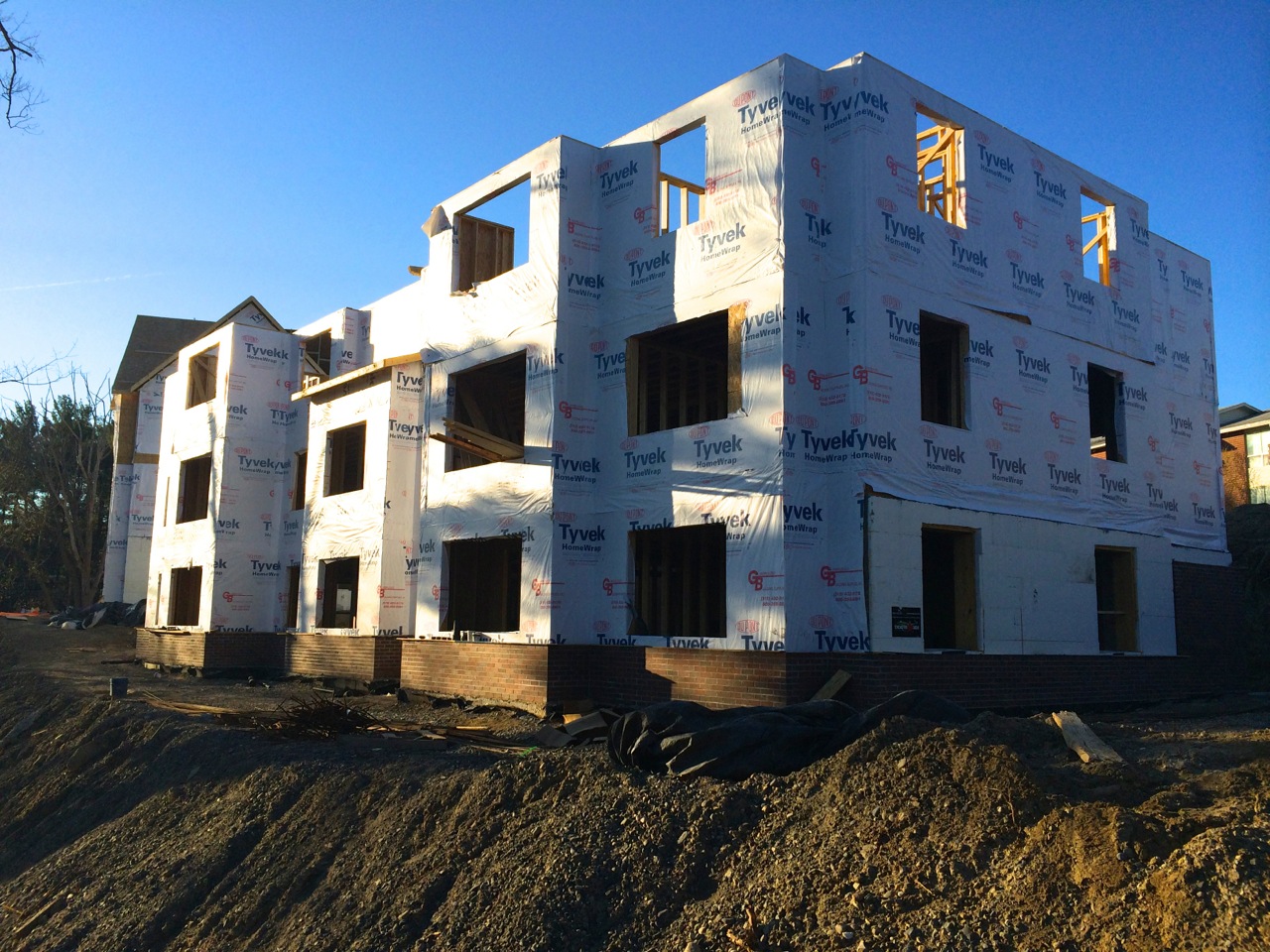
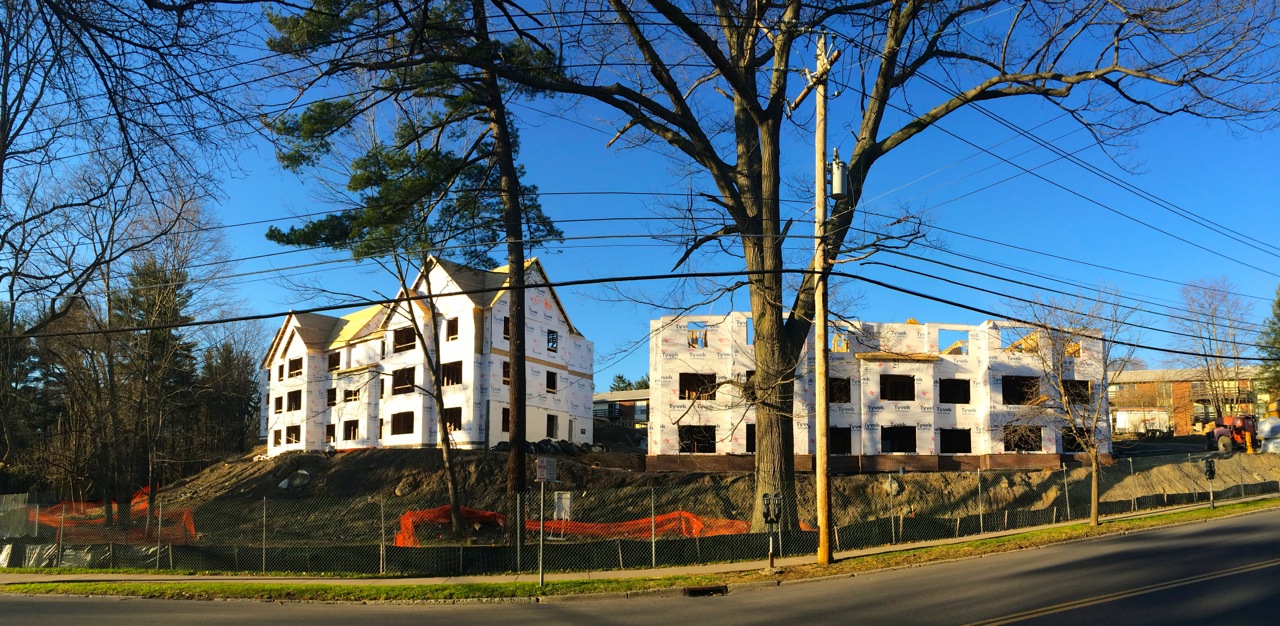
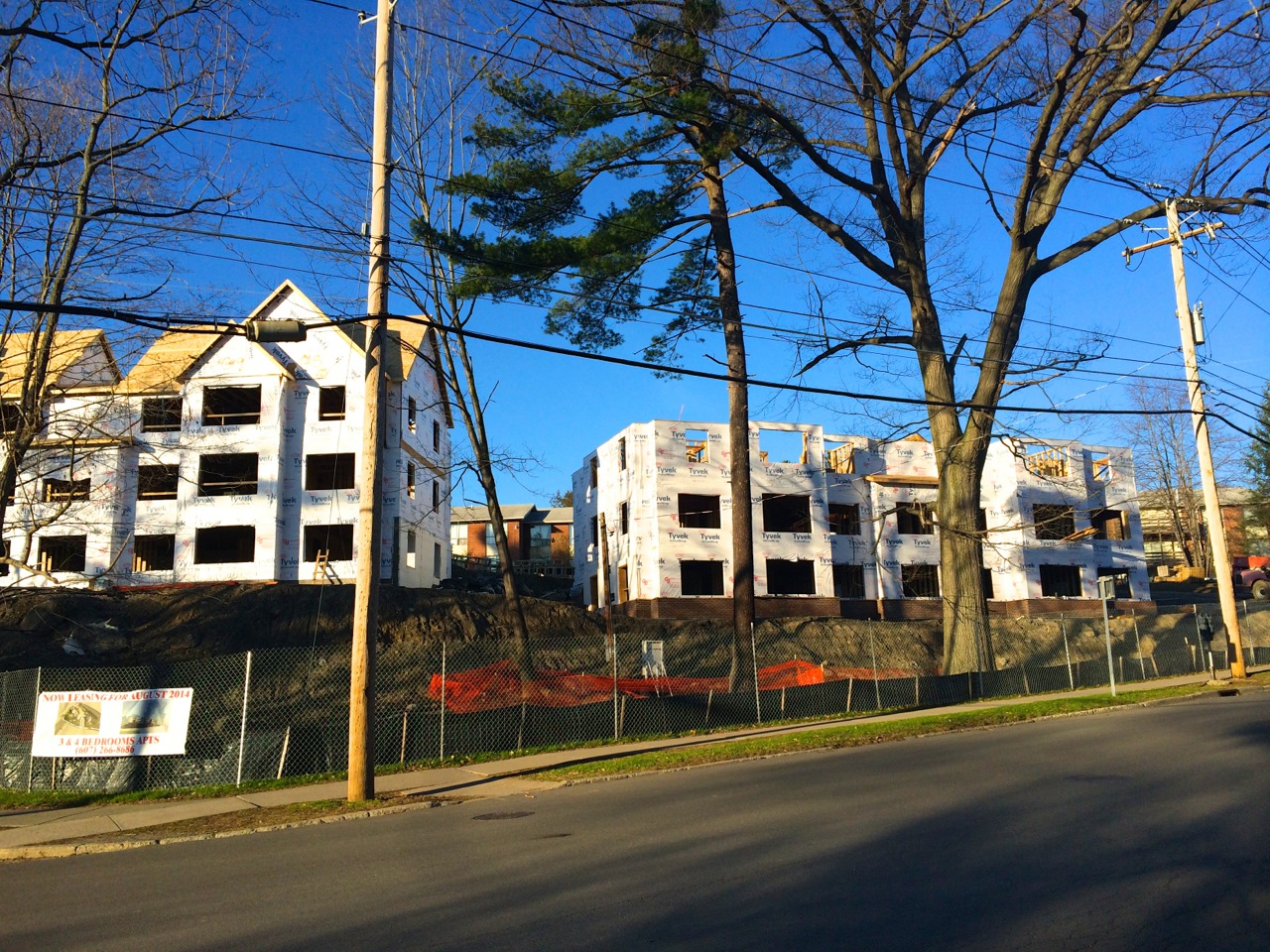
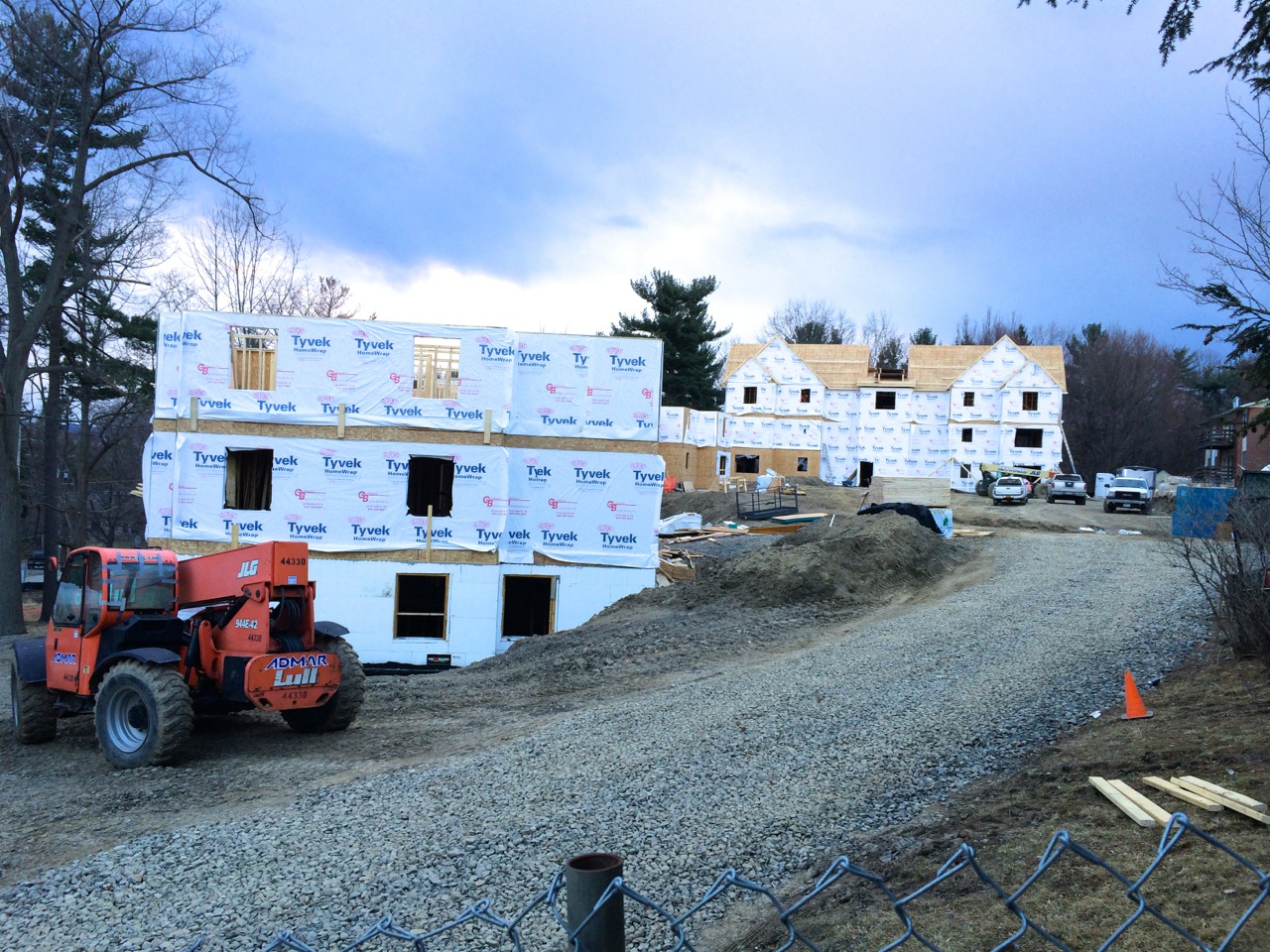
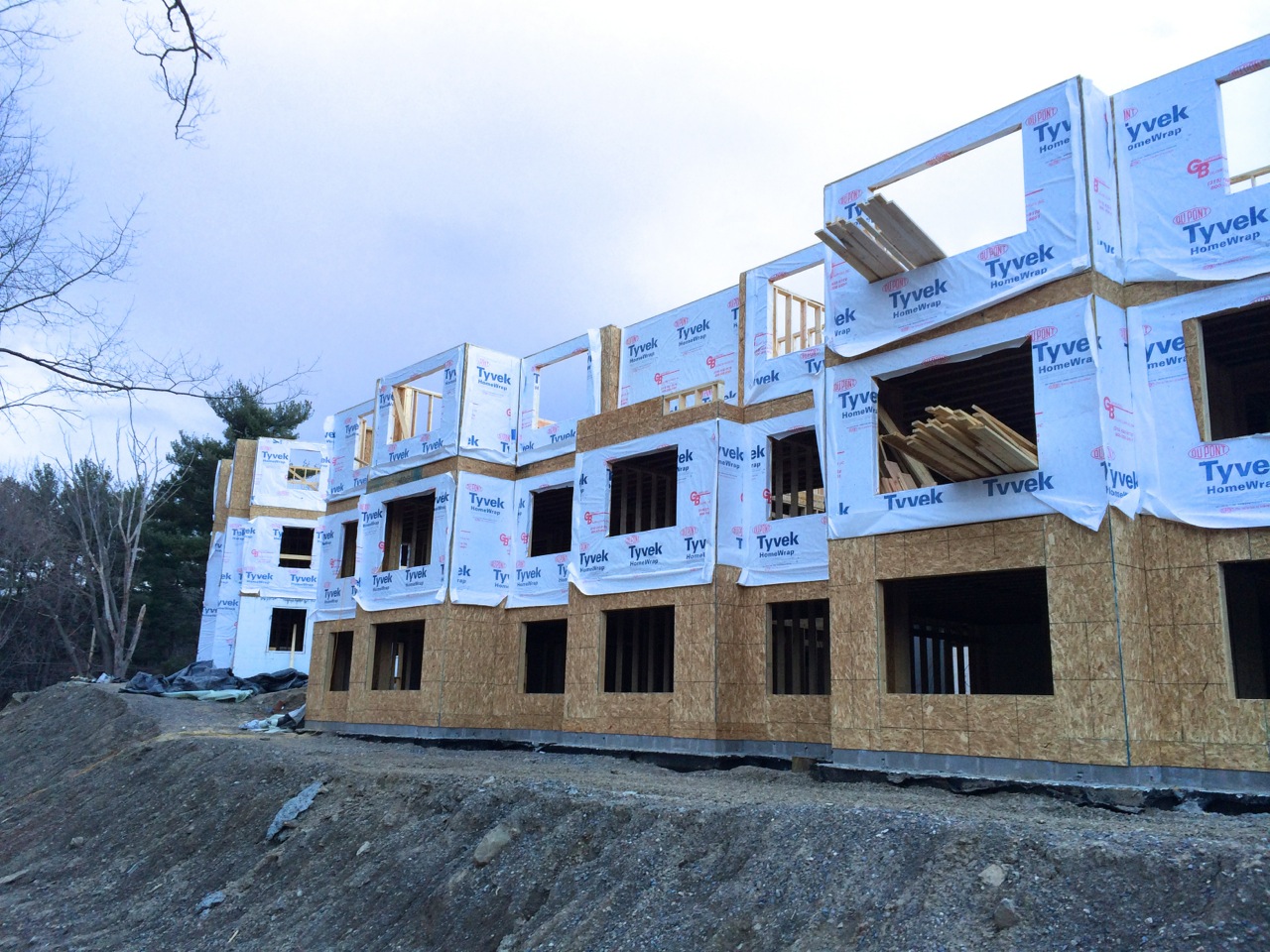
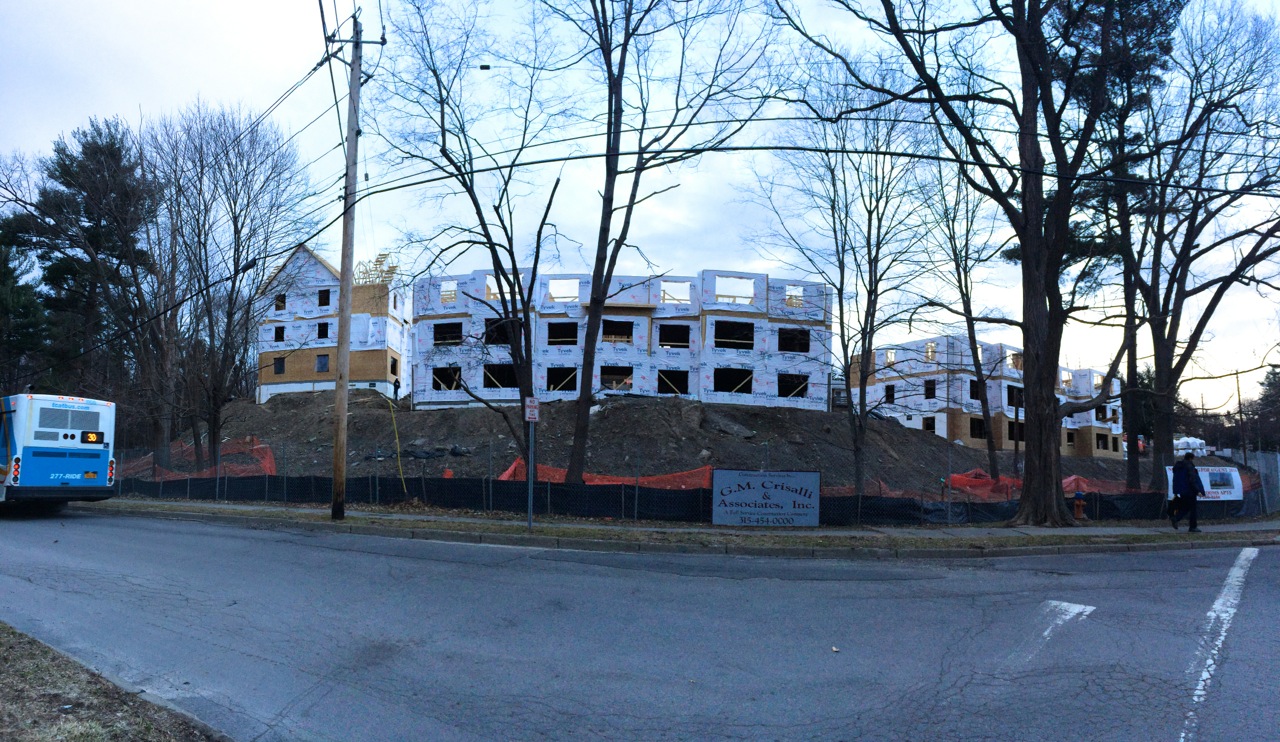
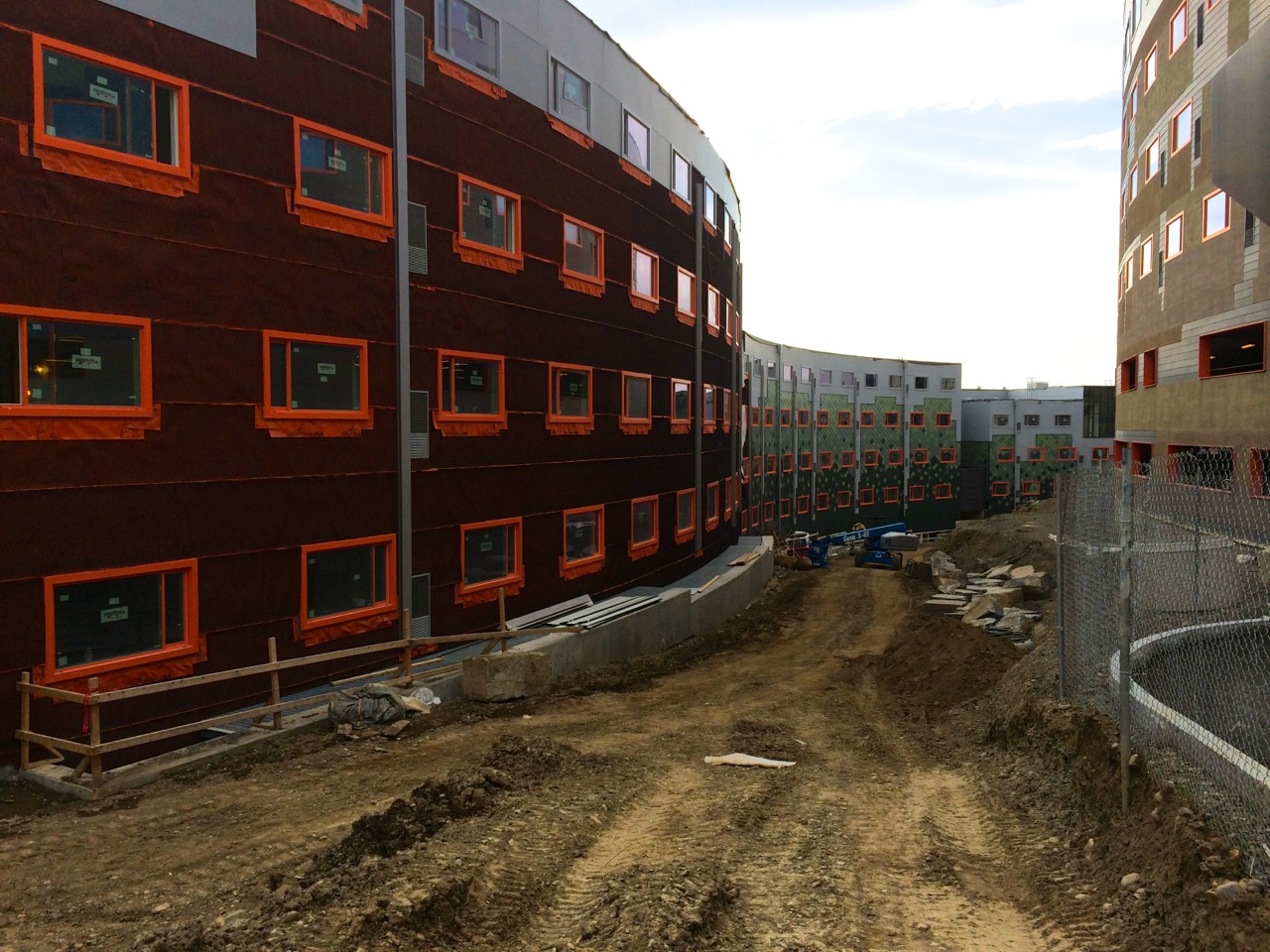
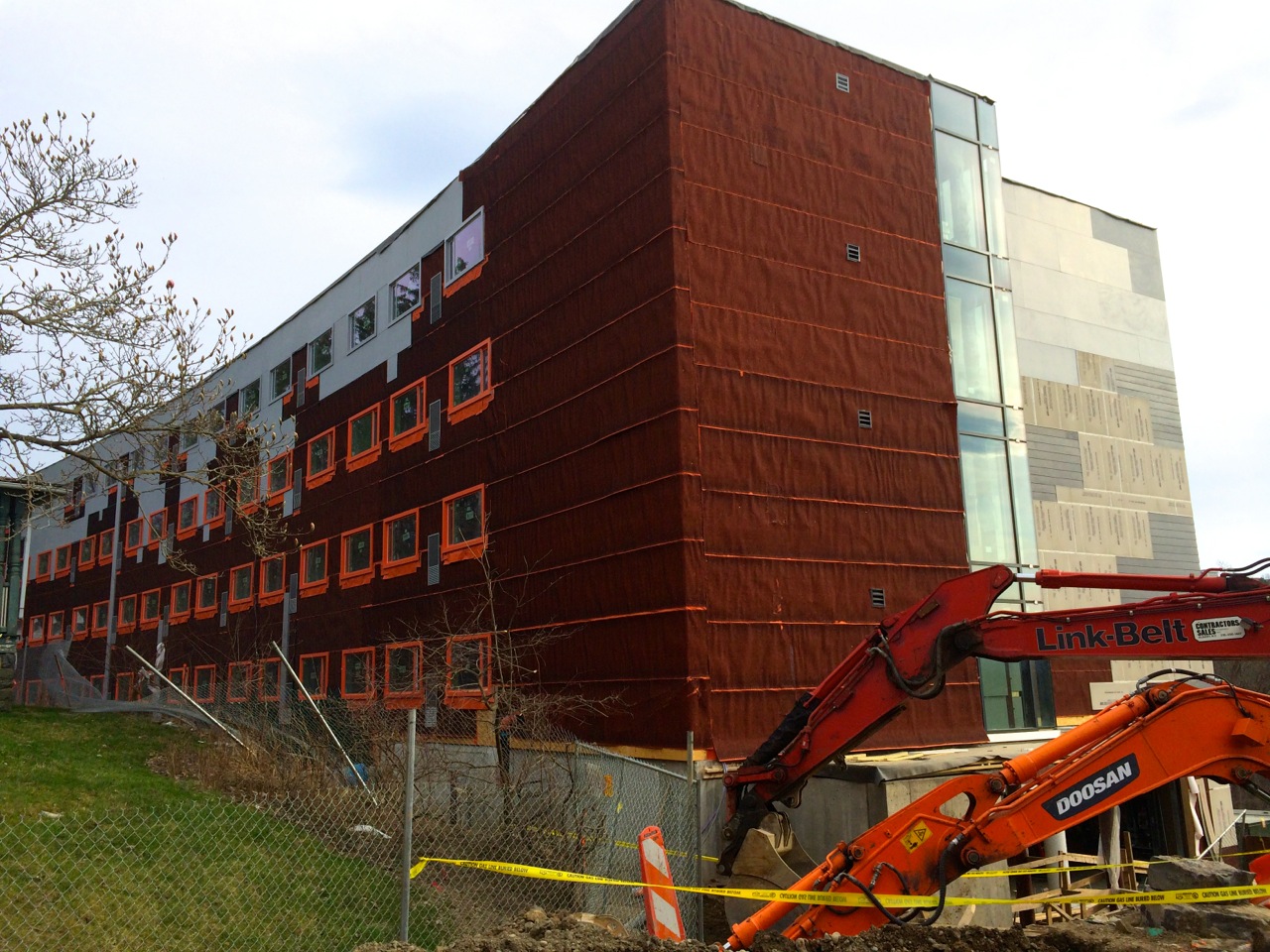
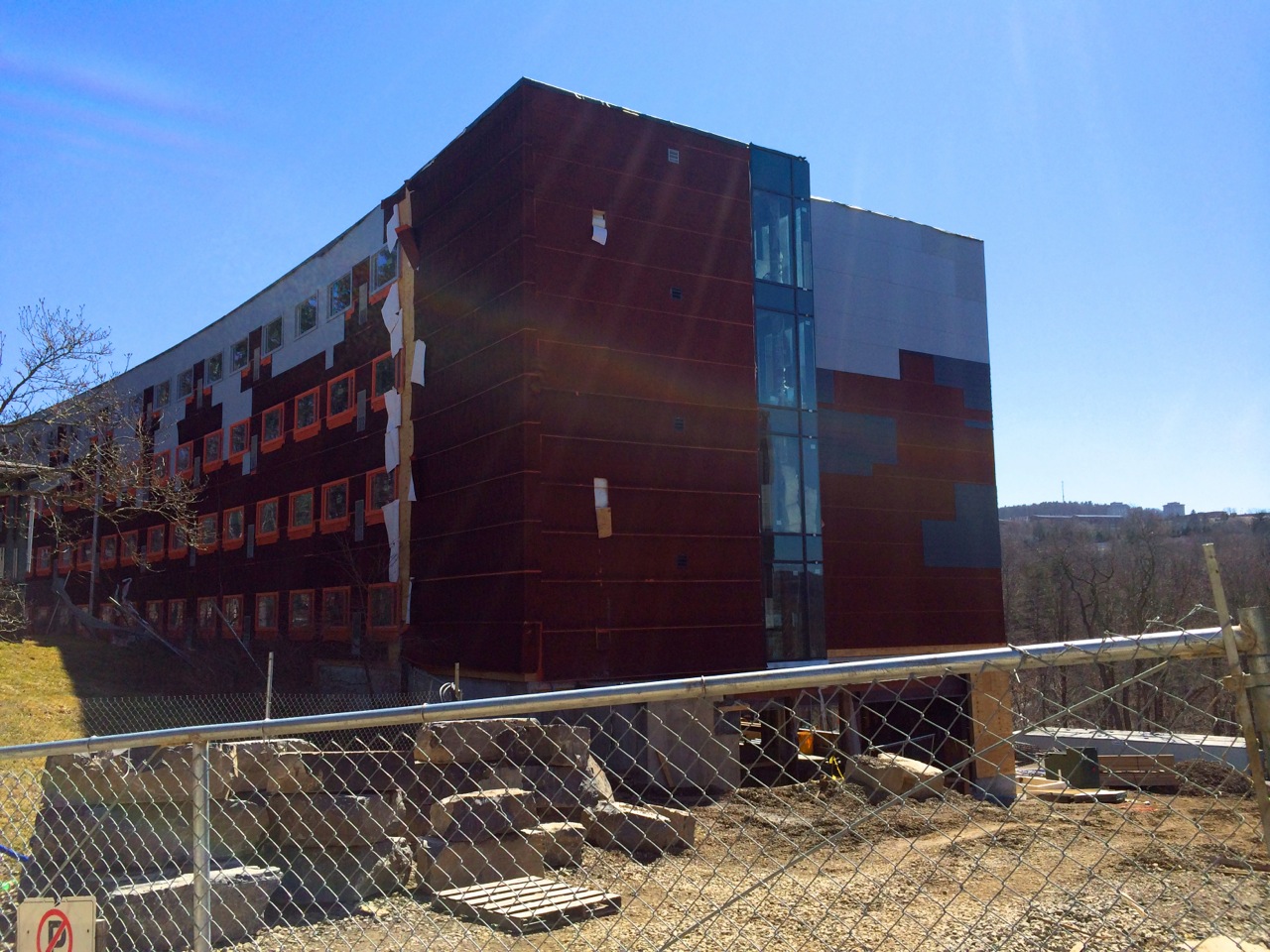
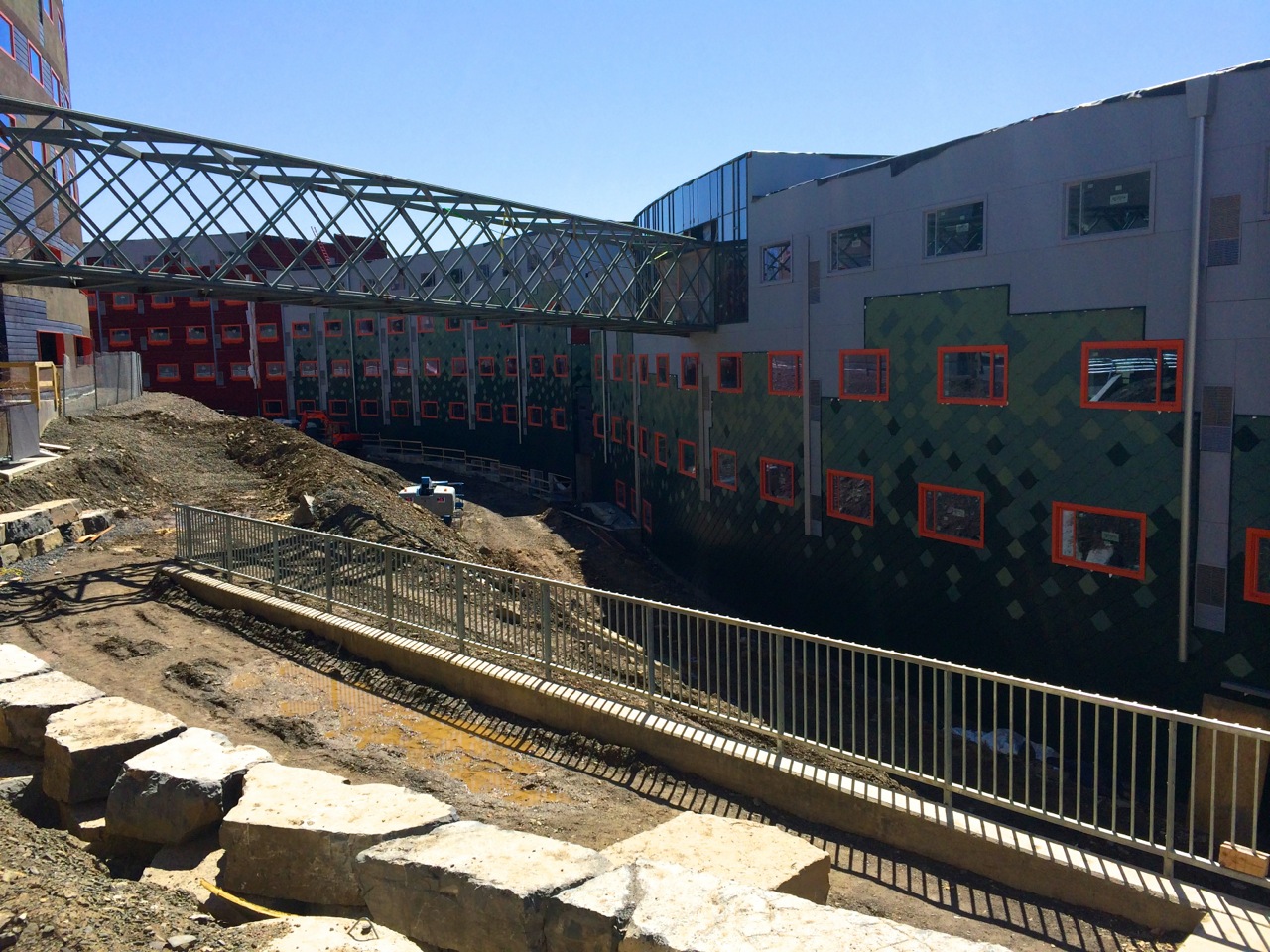
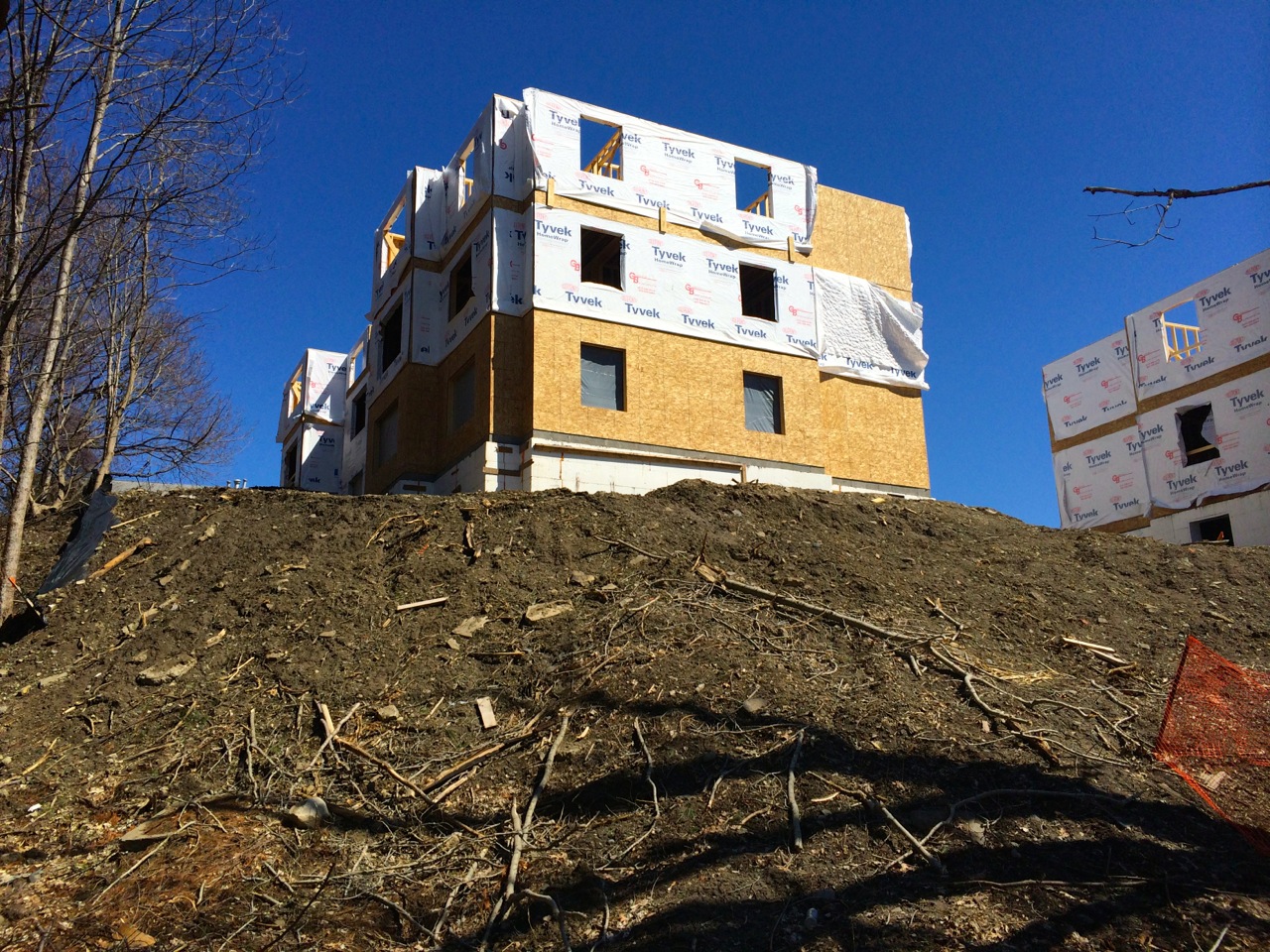
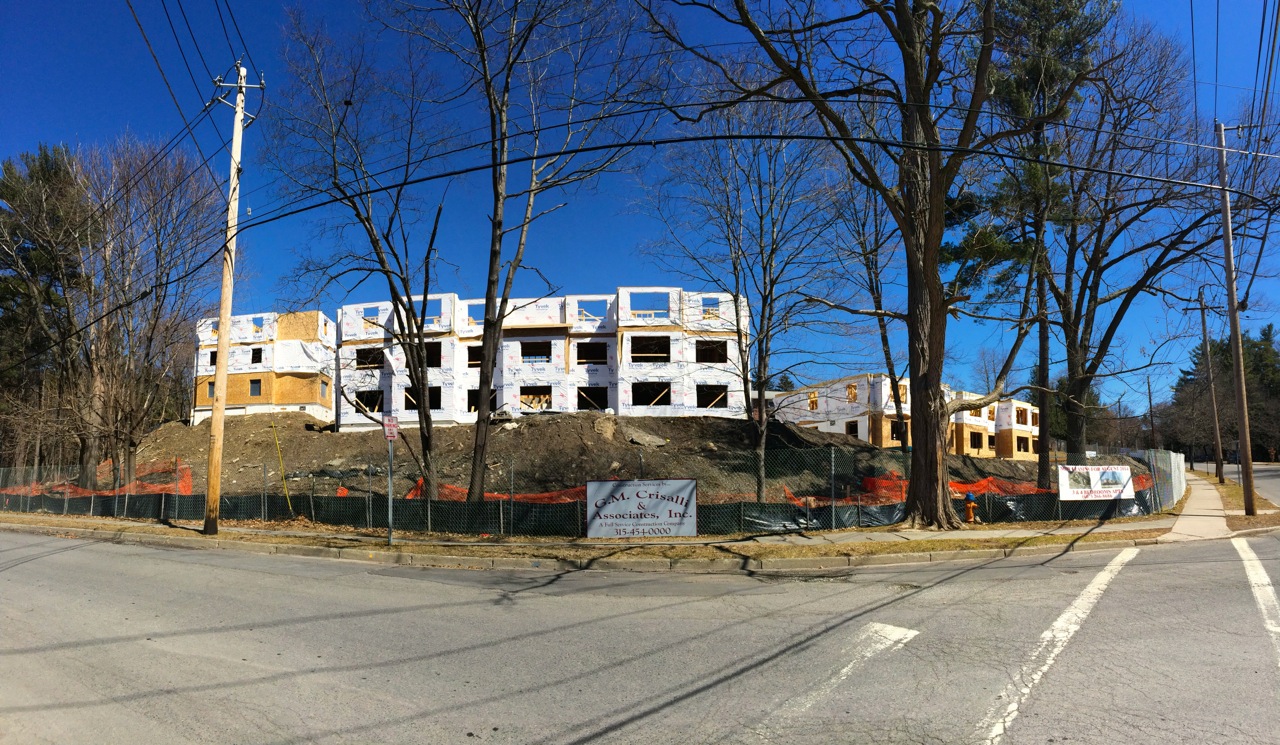
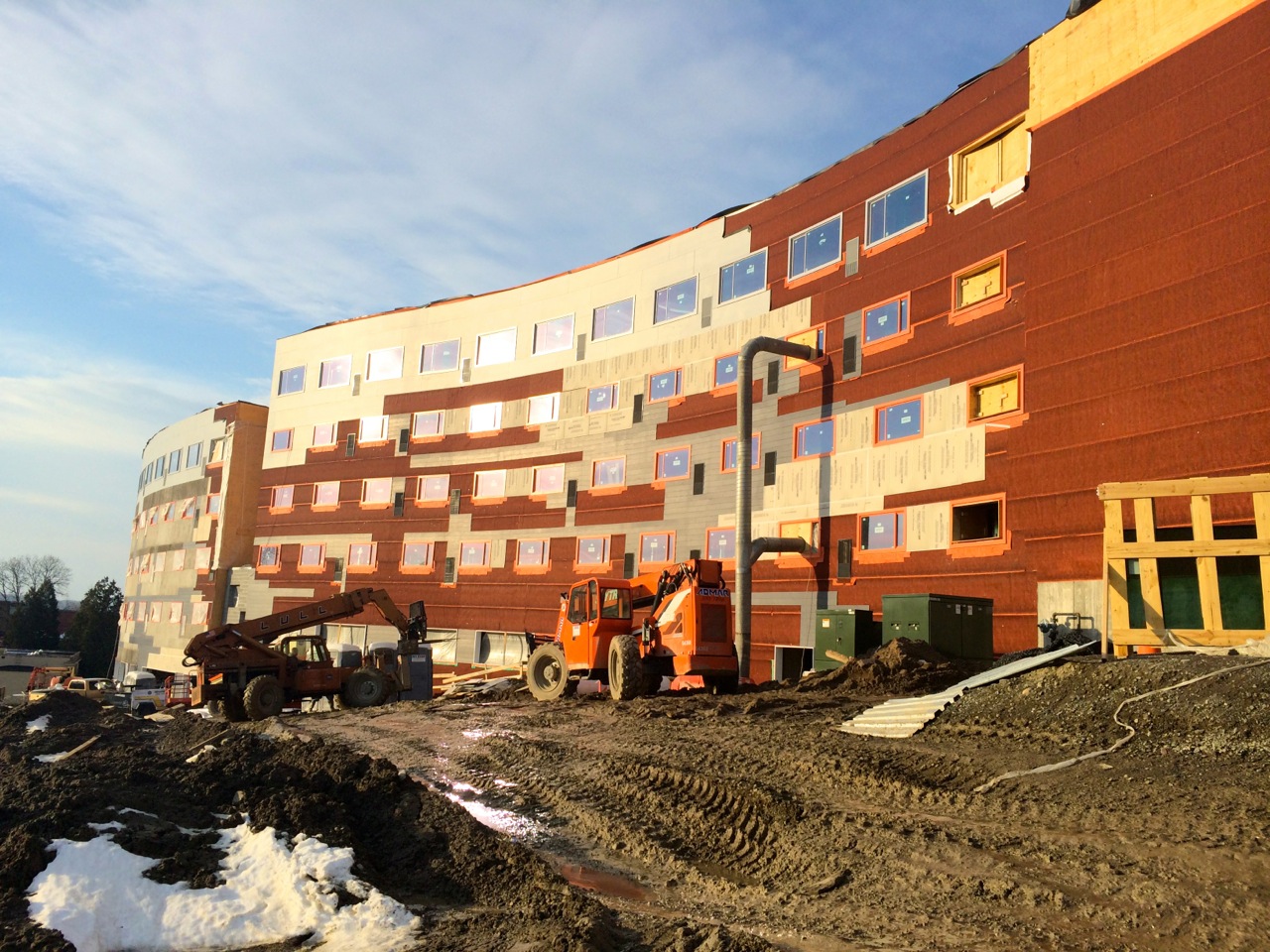
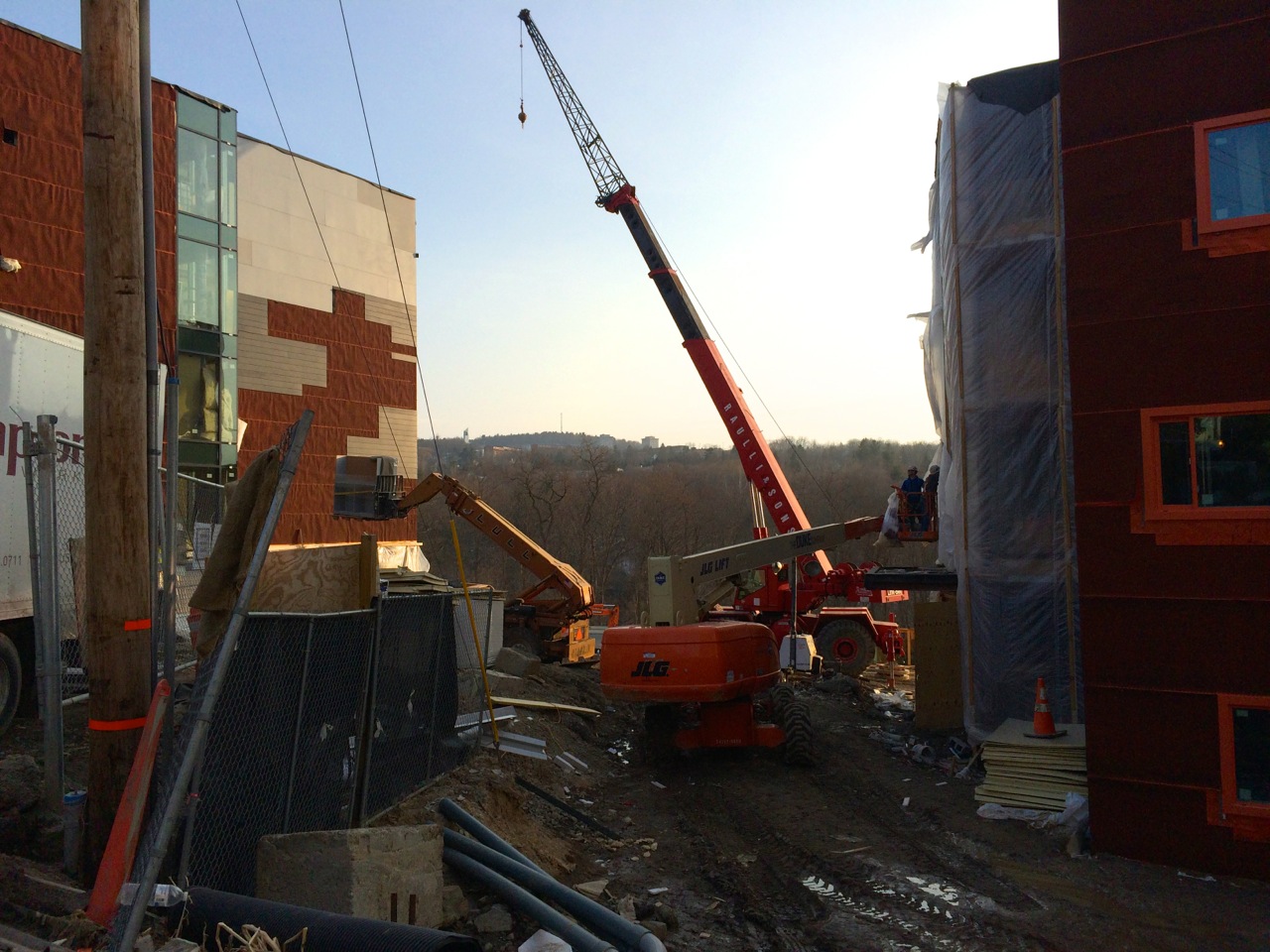
RABCO Highland House’s Thurston Avenue Apartments project has continued framing progress, as all three Buildings have topped-out to their final storeys, and Buildings B and C have complete trusses and plywood roofs. Building D is being trussed this week, which will conclude the framing that can be seen from the exterior. The exterior walls have been fully wrapped with Tyvek water barrier wrap, and roofing tiles began install last week.

The general contractor on this project is G.M. Crisalli, with framing by Compass Builders, and design by HOLT Architects.

Photos from April 24th:
Thurston-Ave-Apartments-Ithaca-04241406

Building C:
Thurston-Ave-Apartments-Ithaca-04241407

Building D:
Thurston-Ave-Apartments-Ithaca-04241409

Photos from April 10th:
Thurston-Ave-Apartments-Ithaca-410142

Thurston-Ave-Apartments-Ithaca-410141

Affordable Housing in Ithaca (Part One)

April 23, 2014 // by Jason Henderson

Odds are, if you poll people on the street in Ithaca and ask them to name the most pressing problem in the City, the prevailing answer would be the lack of affordable housing. Over the years, we’ve managed to run up a housing market demand that overruns housing supply.

The Breckenridge Place ribbon-cutting ceremony last May 26th presented a startling reminder of how the lack of affordable housing threatens vulnerable populations, and why it’s so difficult to accomplish.

Among the speakers was Ithaca Mayor Svante Myrick, whom spoke of his own experiences growing up with housing uncertainty, and at times, literally homeless. It’s important for us to define housing as a basic need in society, but also housing that is located near downtowns, civic institutions, and economic centers, so that residents are able to take full advantage of social and economic opportunities. Svante made the same point by recalling that his family had lived in a nicely-furnished affordable housing complex for two years, but it had been very far from a town center, which severely reduced the benefits of the housing due to the lack of reasonable mobility to places of work, to basic needs like groceries, and to local resources.

Downtown affordable housing developments are tremendously difficult projects to accomplish, primarily due to the cost of building and financing projects under current building codes, costs, and site availability. Not to say building codes, costs, or site availability are to blame: codes keep people safe, costs are largely predetermined due to wages, materials, and technology, and site availability due to existing productive structures and planning considerations.

At the ceremony, Paul Mazzarella, director of Ithaca Neighborhood Housing Services, introduced Stuart J. Mitchell, CEO of Pathstone Development Corp. (project partner-developer), whom emphasized the complexity of the financing and planning involved in Breckenridge. Generally nowadays, affordable housing projects are complicated public/private/not-for-profit deals that leverage a slew of public and grant funding sources with private equity to finance the construction. The legal and tax benefits of each corporate structure are utilized to take full advantage of each of the funding nuances in order to make the project happen, a bit like putting together a financial puzzle set.

Programs like the Federal Low Income Housing Tax Credit (LIHTC), NYS Homes & Community Renewal programs (NYSDHCR), and federal neighborhood revitalization grants are typically oversubscribed, especially programs for urban multifamily housing development. LIHTC is said to be oversubscribed 3 to 1 with project applications each funding cycle. Organizations like Smart Growth America’s LOCUS are actively pushing federal and state governments to gear their programs towards smarter (denser, downtown) developments in order to re-align incentives with the existing and future sustainable American market for housing.

I wanted to present the current picture in Ithaca, and coincidentally, Paul gave a great presentation on housing trends in Ithaca and Tompkins County to the City Planning Committee last February 12th, and has agreed to share the slides here on the blog. Here’s a selection of slides from the presentation with brief explanations:

Slide04

Housing sales cost trends show that from 2000 to 2013, prices have increased about twice as fast as income growth, and the fastest in urban areas of Tompkins County, especially in the City of Ithaca. The largest percentage of price gains have been in the lowest quartile of the housing market, essentially pricing-out many buyers from the lower end of the market.

Slide06

Regionally, we have the greatest gap between median purchase price and median family income:

Slide08

Affordable (defined by a multiplier of median income) home sales volumes have slipped:

Slide09

Fair Market Rents (FMRs, defined by the federal government at the 40th percentile of median family income) have increased dramatically from 2000 to 2014:

Slide10

Tompkins County’s FMRs are almost twice as expensive as some nearby counties:

Slide11

Rental housing in Ithaca is clearly dominated by student housing, which has been the intended consumer for most new multifamily rental development since 1980, however, rental housing development has not kept pace with demand for new units.

rental-housing-production-ithaca

The vacancy rate for apartments in the Ithaca urban area is 0.5%, which is far below the 5% rate considered to be a good rule of thumb for a desirable and competitive market. If not enough units are left vacant, the market is incentivized towards supplying sub-standard housing for the revenues the units command. In addition, the burden of finding housing imposes a cost to consumers. There are demographic changes that drive this housing demand: the City of Ithaca has seen minimal population growth (just less than 1%) from 1990 to 2010, while the County has seen growth around 8%. Part of the discrepancy can be traced to the lack of affordable and new housing created in the City.

Employment is arguably the major driver, since living closer to work is desirable; from 2000 to 2013, the change in private employment looks like this:

change-in-employment
(MSA= Metropolitan Statistical Area)

The New York State Comptroller’s Office recently published a report (March 2014) on housing affordability in New York State, and the figures statewide are quite grim. According to the State, housing affordability is defined by housing costs being a portion of 30% or less of household income. Housing costs are defined not only by rent or mortgage payments, but also utilities, insurance, and real estate taxes. Severe housing burden is a 50% cost-share of household income.

nysc-homes

nysc-rents

Tompkins County’s numbers may be skewed due to the fact that student households with ACS-sampled low incomes but high rents are included in the Census Bureau statistics, and thus, the reported percentage (47.8%) of rental households above affordability thresholds may not be accurate. The percentage of owner households above the affordability threshold is likely to be much more accurate, at 21.8%, since students generally do not own the property they live in.

Regardless, the reality in Ithaca is that many people are priced out of the market for housing, and the solutions are not easy. Breckenridge was the first affordable housing development in the downtown area in 30 years.

nysc-rents-map

The Second Part in this series will put on “Developer Goggles”: I’ll present and explain a traditionally-financed development pro forma (cost, financing, and cash flow analysis) with up-to-date construction cost information, financing terms, and typical operating revenue and expenses to show a developer’s financial view of building and operating a sample project in Ithaca.

My thanks to Paul for sharing the presentation on housing trends. You can find out more about the mission and history of INHS at their website: Ithaca Neighborhood Housing Services

7 Ridgewood Road Proposal: April Site Plan Review Meeting

April 22, 2014 // by Jason Henderson

Ithacating picked up this project in the initial planning stages this past December, and throughout the planning stages the project has been re-worked, and has also been the subject of an online petition, and a withdrawn re-zoning proposal that would have eliminated the project altogether.

The revised 105,790 square foot project shows three 3-story buildings (plus underground parking) with a total of 45 units and 114 beds with 57 parking spaces on the 2 1/2 acre parcel. There are also four loading spaces, 36 covered bicycle spaces and 6 uncovered. In the latest site plan, Building One’s footprint has been altered to accommodate the 25′ setback under the R-U zoning. The updated slides were also presented in a public meeting on April 15th to local neighbors, where questions and comments about this project, housing development in Ithaca, zoning, and the Thurston Avenue Apartments project were discussed.

The City of Ithaca Planning & Development Meeting focused on the updated landscaping plans, the green roofs, cladding materials (stone selections, lapboard, fiber cement board) and project considerations included in the Full Environmental Assessment Form (FEAF), which includes exhibit sections on the impact on land, flooding, plants and animals, aesthetic resources/community character, cultural resources, transportation, and human health.

The project is being developed by CA Student Living, LLC (a CA-Ventures project, formerly Campus Acquisitions), and designed by architecture firm Shepley Bulfinch out of Boston, with local design assistance by Trowbridge Wolf Michaels Landscape Architects, Elwyn & Palmer Consulting Engineers, and legal representation by Phillips Lytle LLP out of Rochester.

Project Render:
Ridgewood-Snap-Render

Site Plan:
Ridgewood-Snap-Site-Plan

Photo Simulations of Views from Nearby:
Ridgewood-Snap-Photo-Sims

Zoning Analysis:
Ridgewood-Snap-Zoning

Building One Elevation:
Ridgewood-Snap-Building-1-Elevation

Floor Plans:
Ridgewood-Snap-Floor-Plates

Collegetown Terrace Mid-April Photos

April 22, 2014 // by Jason Henderson

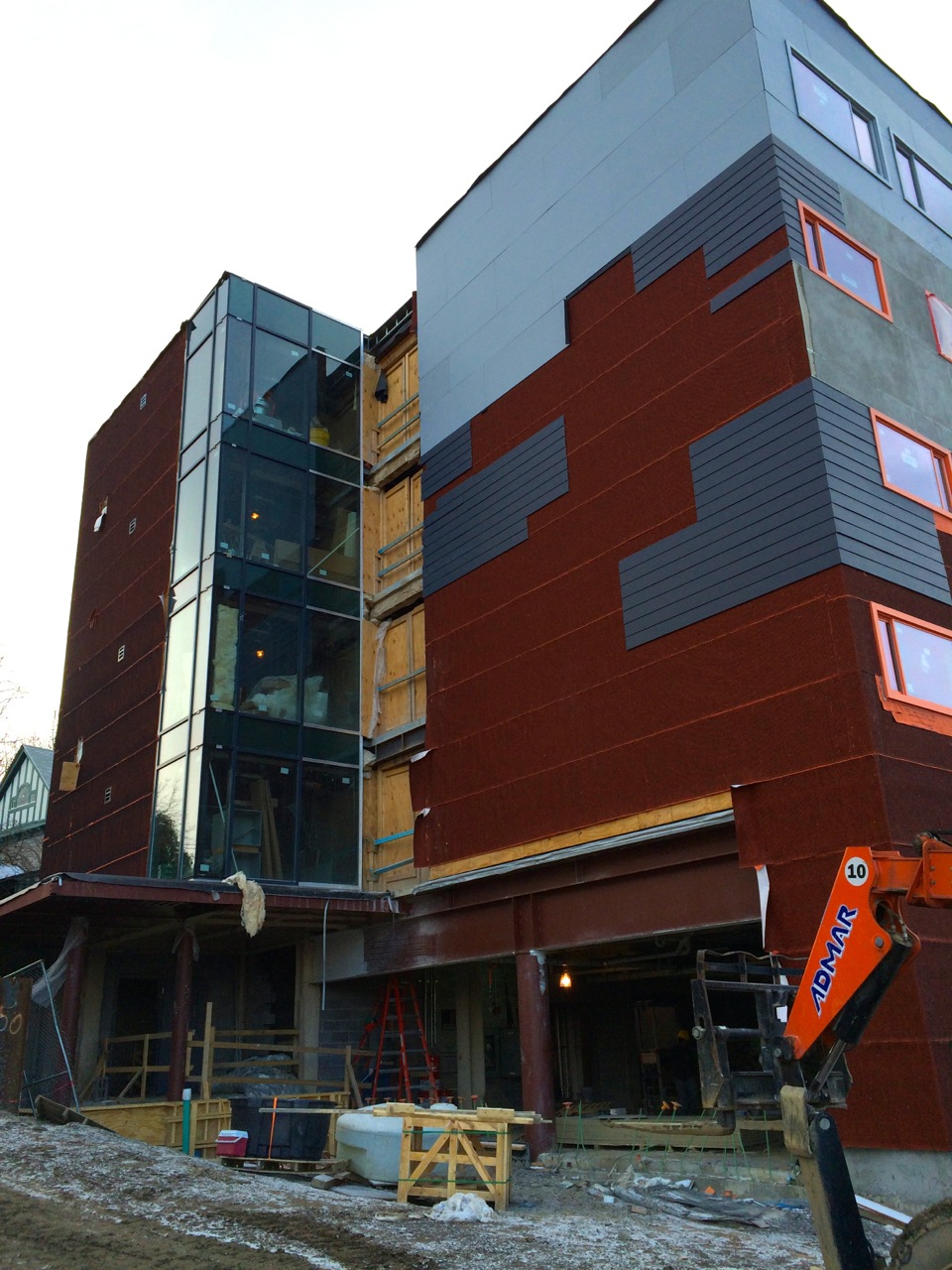
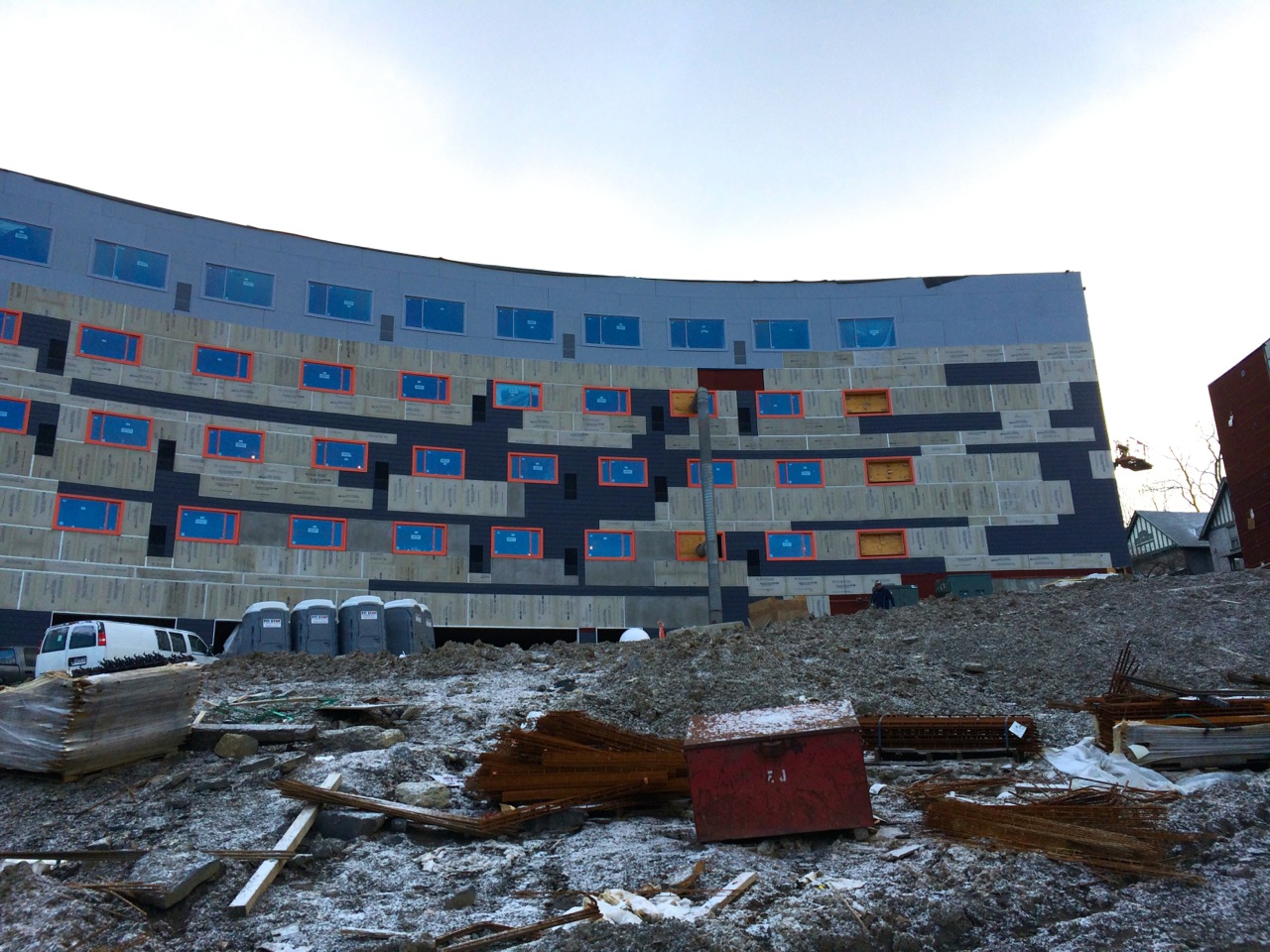
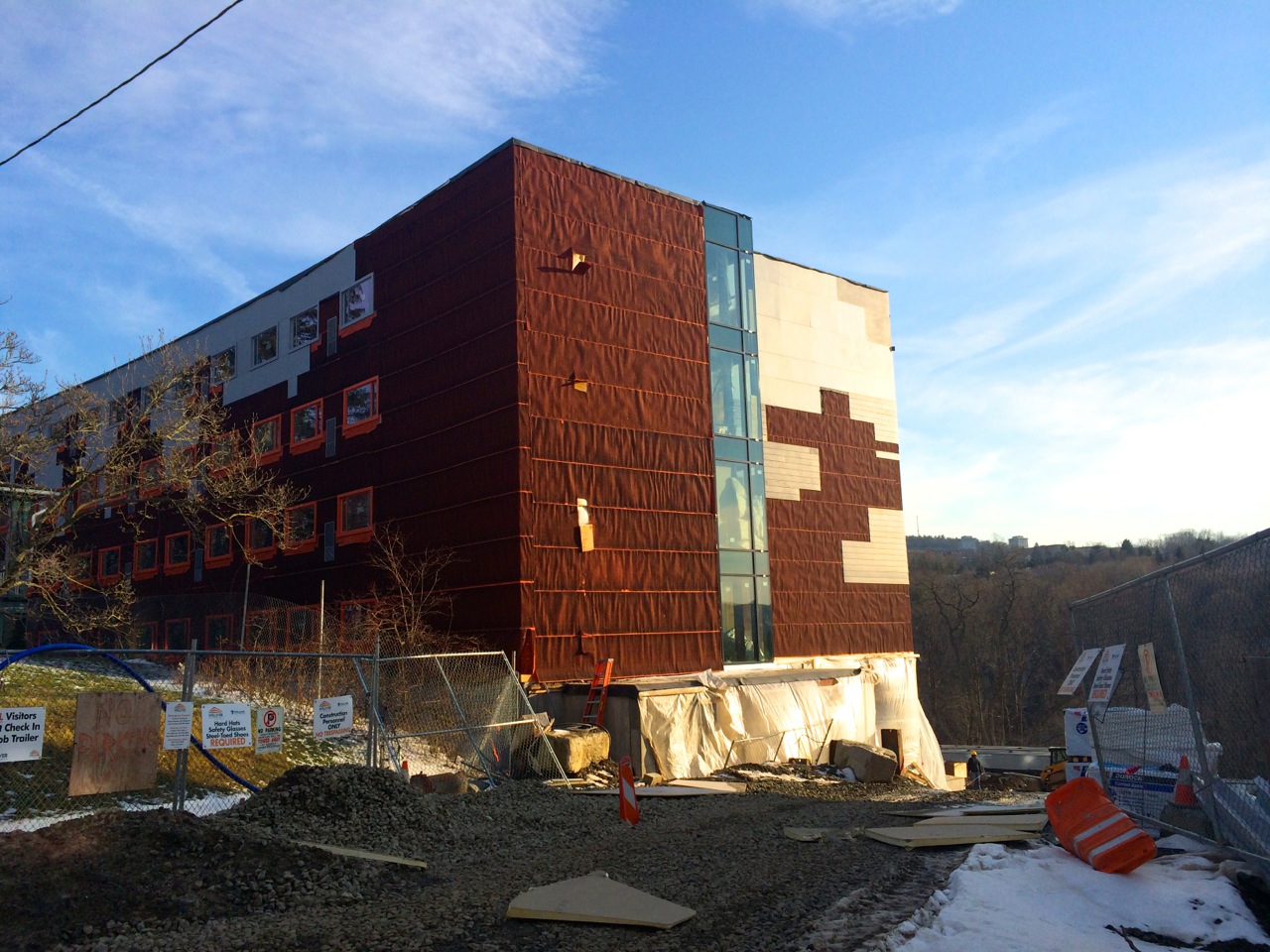
I was invited to take photos on the Collegetown Terrace site last week through Welliver the General Contractor, so here’s a selection of photos from the south side of the site, and a few taken from the north on the 21st. Building 5 and 6 still have sections of fiber cement panels to install (mostly along the north sides), but the southern facades seem complete minus the areas for synthetic stucco, which are applied with a grey base layer, then a tan-colored finish coat.

Concrete forms and rebar rods have been set for the outside stair section at the west end of Building 5, and very large landscaping boulders are being assembled along the hillside just south of the workout facility. Building 5’s eastern stairwell has also been fully-clad in glass panelling. I was mistaken in earlier posts about the timing for Building 7: due to the appeal to reduce planned parking and increase housing units before the City of Ithaca Board of Zoning Appeals, and the fact that the building is still in design phase, the timing for the project will probably fall into next year for starting excavation and sitework.

Buildings 5 then 6 (left to right):
Collegetown_Terrace_Ithaca_04161413

Collegetown_Terrace_Ithaca_04161405

Collegetown_Terrace_Ithaca_04161411

Building 5 south face:
Collegetown_Terrace_Ithaca_04161408

Building 5 north face (on right):
Collegetown_Terrace_Ithaca_0421146

Site Plan:
Collegetown-Terrace-Site-Plan

My thanks to Welliver for the site visit

Collegetown Terrace Early April Photo Update

April 8, 2014 // by Jason Henderson

Some facade-panelling has progressed on Collegetown Terrace‘s Buildings 5 & 6 since mid-march, and Building 5’s eastern stairwell has its steel window wall framing installed, so glass should follow-up soon to match the installation currently on Building 6’s western end. The stairwell ends were used for loading-in building materials, so the closing-up is probably a good sign that the interior is well on its way.

Building 5 south face:

Collegetown-Terrace-Ithaca-04061404

Collegetown-Terrace-Ithaca-04061405

Collegetown-Terrace-Ithaca-04061401

Building 5 east end:
Collegetown-Terrace-Ithaca-04061411

Building 5 north face:
Collegetown-Terrace-Ithaca-04061413

Thurston Avenue Apartments Framing Blitz

April 6, 2014 // by Jason Henderson

The RABCO Highland House Thurston Avenue Apartments project being constructed by G.M. Crisalli has made some impressive framing progress, as Buildings C & D have topped their final storeys since late March, and Building B has gone up another storey, and is almost ready for its third and final. I’ve learned that Building A, the smaller building that had been planned for the right-side entry on this site has been postponed. Building A would have contained 2 one-bedroom units, so the pending unit count on this current project is now 15 three-bedrooms and 3 four-bedrooms:

Thurston Ave Apartments Inventory

Thurston-Ave-Apartments-Birdeye

Thurston-Ave-Apartments-Ithaca-04061411


Photos from April 6th:

Thurston-Ave-Apartments-Ithaca-04061402

Photos from March 29th:

Thurston-Ave-Apartments_0329147

Thurston Avenue Apartments Framing Progress & One Ridgewood Road Photos

March 24, 2014 // by Jason Henderson

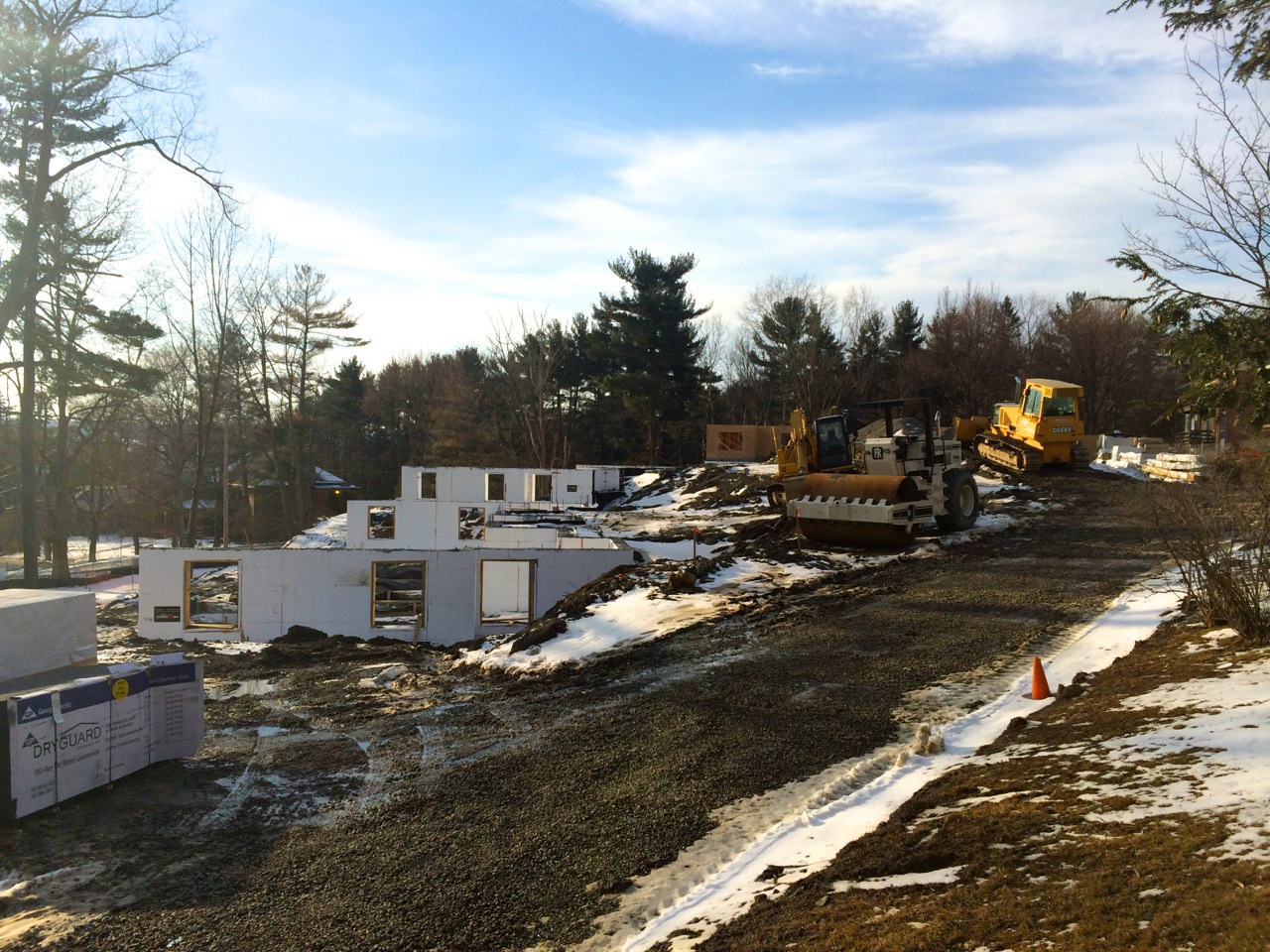
There’s been some framing progress on Building D of RABCO‘s Thurston Avenue Apartments project since early March. The structures are being framed on top of the Insulated Concrete Forms with wood studs and joists, and faced with plywood, then Tyvek wrap on the exterior- the buildings will be fully sprinklered once completed. G.M. Crisalli Construction has been contracted for this project, and Compass Builders has been completing the framing work. Building D will top-out at one more storey plus attic, along with the other three structures.

Thurston_Ave_Apartments_Ithaca_0324146

Thurston_Ave_Apartments_Ithaca_0324145

Thurston-Ave-Apartments-Birdeye

Photos from March 24th:

Photos from March 14th:

The proposed One Ridgewood Road project site is just across the street from here, so I took a few photos of each side.

Ithacating has great information on the project, and a nice explanation of the petition developments here.

Highland Avenue side:

Ridgewood Road side:

One_Ridgewood_Road_Ithaca_0324142

Collegetown Terrace Mid-March Project Photos

March 16, 2014 // by Jason Henderson

Novarr-Mackesey‘s Collegetown Terrace project is showing good progress on both facades of Building 5 & 6, as work by Welliver is picking-up steam on the exterior for the start of construction season, which will likely coincide with the start for Building 7 along the southern edge of the site. Both buildings have full polypropylene wrap, and the northern facade of Building 5 looks complete along the western end (except the stair tower), and both southern faces of Building 5 & 6 are moving along with what I believe are a combination of fiber cement panels, metal panels, and sections of synthetic stucco. It’s hard to believe, but only 5 months ago, Building 6 looked like this (left), and this end of Building 5 looked like this (right):

Collegetown_Terrace_10202-October-Two

Now in March 2014, we’re coming-up on both Buildings 5 & 6 ready for leasing for the start of Fall semester, which, as noted in Ithacating, means an addition of 167 units (Building 5) and 71 units (Building 6), for a total of 238 units. Building 7 is now planning for 247 units (up from 178), with the appeal before the Board of Zoning Appeals to convert the second parking level to dorm-style units, which will be leased at more affordable rates. The appeal must be sought due to zoning for minimum parking requirements and minimum lot area per number of housing units.

Photos from Friday, March 14th:

Building 5:
Collegetown_Terrace_Ithaca_03141407

Building 6:
Collegetown_Terrace_Ithaca_03141408

South end of the site, where excavation for Building 7 will begin this year:
Collegetown_Terrace_Ithaca_03141403

North face of Building 5:
Collegetown_Terrace_Ithaca_03141415

128 West Falls Street Heritage Park Townhouses Project

March 9, 2014 // by Jason Henderson

Heritage Builders / Heritage Park Townhomes is proposing to construct a three-building rental project at 128 West Falls Street, at the northern edge of the Fall Creek neighborhood (across the street from McPherson Builders), adjacent to Route 13. The project proposes to subdivide the 128 West Falls Street (16,352 SF) lot into three lots, keep the existing house, and build one house on a 4,054 SF lot, one house on a 4,022 SF lot, and a double-house on the remainder 8,276 SF lot, at a projected cost of $485,000. The anticipated construction schedule is this year, May 2014, going to May 2016.

The Ithaca Journal noted that a petition has circulated in the area to prevent the project from moving forward, and Ron Ronsvalle, the owner of Heritage Park Townhomes, commented on the zoning variance that is required for the project to proceed. Essentially, the required front yard setback of 10′ is not met due to the existing building being too close (5.2′). The lot subdivision triggers a zoning review of all parcels, and since the house is being kept, it falls under that review. The proposed structures meet current zoning requirements.

Heritage Builders has done a few recent rental projects downtown (see Lincoln Street homes), and owns and manages various apartment & townhome buildings, vacation, and commercial properties. In addition to designing this project, Lawrence John Fabbroni of Fabbroni Associates also designed the Lincoln Street buildings.

128-West-Falls-Street---SPR---Site-Plans-and-Elevations---02-25-14

128-West-Falls-Street---SPR---Site-Plans-and-Elevations---02-25-14-2

Google Earth Street View from Route 13 (trees have since been cleared):

128-West-Falls-St


Applicant Cover Letter

Site Plan Review Application

Site Plan and Elevations

Full Environmental Assessment Form (FEAF) Part 1

Zoning Appeal Matrix

Cayuga Place Residences Moving Forward this Year

March 5, 2014 // by Jason Henderson

Bloomfield/Schon’s 45-unit Cayuga Place Residences project looks set to break ground this year, as the Ithaca Times has reported that the team has come up with a foundation system addressing the poor soil conditions, and financing for the project has been secured. The land purchase option will be extended by the City and a $10,000 payment by the developer so that the bank financing the project can finalize their review of the Phase 2 Environmental Site Assessment and subsequently provide proof of financing.

The design and engineering team came up with a plan to use “shallow depth augur grouted steel core displacement piles,” probably from IDEAL, a company based out of Rochester, NY that manufactures a system called STELCOR. The drilling auger goes into the soil, creates displacement in the soil, then the reservoir gap is filled with grout, water is poured in for the mixture to cure, then the interior core of the steel auger is filled with grout, and topped-off. The steel auger core stays in the ground as part of the structure of the pile.

Cayuga_Place_Residences_0224142

Ideal-Stelcor

Cayuga_Place_2_Shot